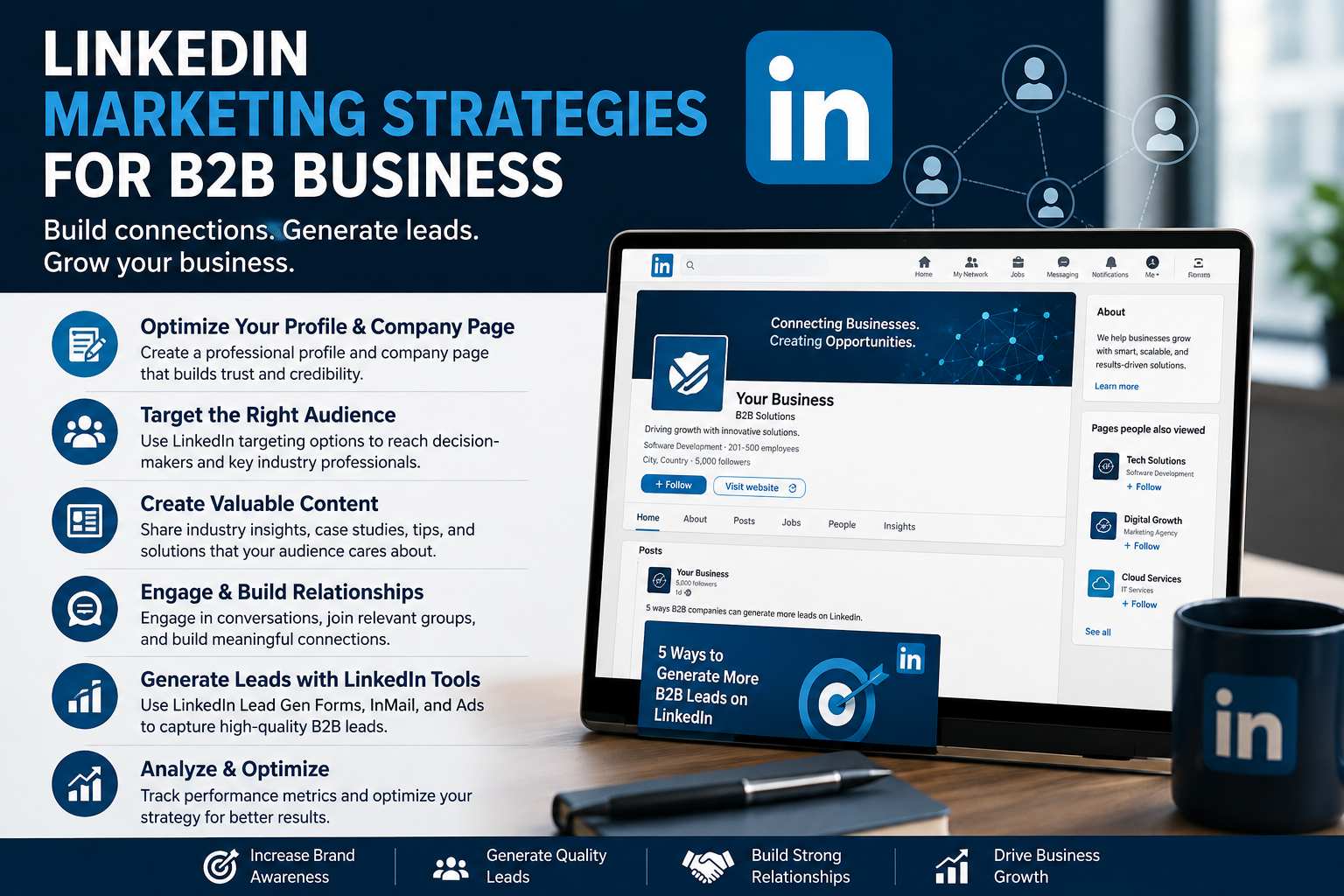
LinkedIn has become one of the most powerful plafor B2B businesses looking to build brand awareness, generate qualified leads, and establish professional relationships. Unlike many other social media platforms, LinkedIn is designed around professional networking, making it an ideal environment for businesses to connect with decision-makers, industry experts, and potential clients.
However, simply creating a LinkedIn company page and posting occasionally is not enough. A successful B2B LinkedIn marketing strategy requires consistent content, audience targeting, relationship building, and performance analysis. Here are some effective LinkedIn marketing strategies that can help B2B businesses grow.
1. Optimize Your LinkedIn Company Page
Your LinkedIn company page is often the first place potential customers visit to learn about your business. Make sure it creates a professional and trustworthy impression.
Use a clear company logo, an attractive cover image, and a compelling company description. Your description should clearly explain what your business does, who you serve, and how your products or services solve customer problems.
Include relevant industry keywords naturally in your company description. This can improve your visibility when users search for businesses or services related to your industry.
2. Define Your Target Audience
Effective B2B marketing starts with understanding your ideal customer. LinkedIn provides valuable information about professionals, including their job titles, industries, company sizes, locations, and interests.
Create an ideal customer profile before starting your campaigns. Consider questions such as:
- Who makes purchasing decisions?
- Which industries need your services?
- What problems do your potential customers face?
- What type of content do they find useful?
- What company size is most suitable for your business?
Understanding your audience allows you to create content and campaigns that are more relevant and effective.
3. Create Valuable and Educational Content
Content marketing is one of the most important parts of LinkedIn marketing for B2B businesses. Instead of constantly promoting your products or services, focus on providing useful information.
You can create content such as industry insights, how-to guides, case studies, statistics, business tips, customer success stories, and expert opinions.
For example, a digital marketing agency could publish content about SEO trends, social media strategies, content marketing tips, and common advertising mistakes.
The goal is to make your LinkedIn page a valuable source of information for your target audience.
4. Use Different Content Formats
LinkedIn supports several content formats, so businesses should avoid publishing the same type of post repeatedly.
Experiment with text posts, images, videos, documents, polls, infographics, and carousels. Different formats can help you reach different segments of your audience and keep your content interesting.
Short videos can be useful for explaining complex topics, while carousel-style posts can break down information into simple, easy-to-understand sections.
5. Build a Strong Personal Brand
In B2B marketing, people often connect with people before they connect with companies. This makes personal branding an important part of LinkedIn marketing.
Business owners, founders, marketers, sales professionals, and executives can share their experiences, knowledge, opinions, and industry insights through their personal LinkedIn profiles.
Employees can also become brand advocates by sharing company achievements, useful content, and professional experiences. A strong personal brand can increase credibility and make it easier to build relationships with potential customers.
6. Engage With Your Audience
LinkedIn marketing should not be a one-way communication channel. Posting content is only one part of the strategy. Businesses should actively engage with their audience.
Respond to comments, participate in industry discussions, congratulate connections on professional achievements, and engage with posts from potential customers.
Meaningful engagement can increase visibility while helping your business build genuine professional relationships.
7. Use LinkedIn Lead Generation Strategies
LinkedIn can be an effective platform for generating B2B leads. Businesses can use lead magnets such as free guides, industry reports, webinars, checklists, and case studies to encourage potential customers to provide their contact information.
LinkedIn advertising can also help businesses reach highly specific professional audiences. Campaigns can be targeted based on factors such as job title, industry, company size, location, and professional interests.
However, successful lead generation is not simply about collecting a large number of leads. The focus should be on attracting qualified prospects who are likely to become customers.
8. Use LinkedIn Ads Strategically
LinkedIn Ads can help B2B businesses reach decision-makers more efficiently. Sponsored content, lead generation campaigns, message-based advertising, and other advertising formats can support different marketing objectives.
Before launching an advertising campaign, define a clear goal. Your objective could be brand awareness, website traffic, lead generation, event registrations, or conversions.
Create different ad variations and test headlines, visuals, offers, and audience segments. Analyze the results and invest more in campaigns that deliver quality results.
9. Share Case Studies and Customer Success Stories
B2B customers often want evidence before making a purchasing decision. Case studies and testimonials can demonstrate how your business has helped real customers solve specific problems.
A strong case study should explain the customer’s challenge, the solution provided, and the results achieved. Whenever possible, include measurable outcomes such as increased leads, improved efficiency, reduced costs, or higher revenue.
This type of content can build trust and demonstrate your expertise more effectively than promotional posts alone.
10. Analyze Your LinkedIn Performance
A successful LinkedIn marketing strategy should be measured regularly. Track important metrics such as impressions, engagement rate, follower growth, website clicks, leads, and conversions.
Look at which topics and content formats generate the most engagement. Identify the posts that attract your target audience and create more content around similar themes.
For paid campaigns, monitor metrics such as click-through rate, cost per lead, conversion rate, and return on advertising spend.
Data-driven decision-making allows businesses to continuously improve their LinkedIn strategy.
Conclusion
LinkedIn marketing offers B2B businesses an excellent opportunity to reach professional audiences, establish credibility, generate leads, and build long-term relationships. However, success requires more than simply posting promotional content.
A strong strategy combines an optimized company page, clearly defined target audiences, valuable content, personal branding, meaningful engagement, lead generation, paid advertising, and regular performance analysis.
By consistently providing value and building authentic professional relationships, B2B businesses can turn LinkedIn into an important part of their digital marketing strategy. The key is to focus on helping your audience first and selling second.